 PlayBloo
A pilgrimage map of Vietnam
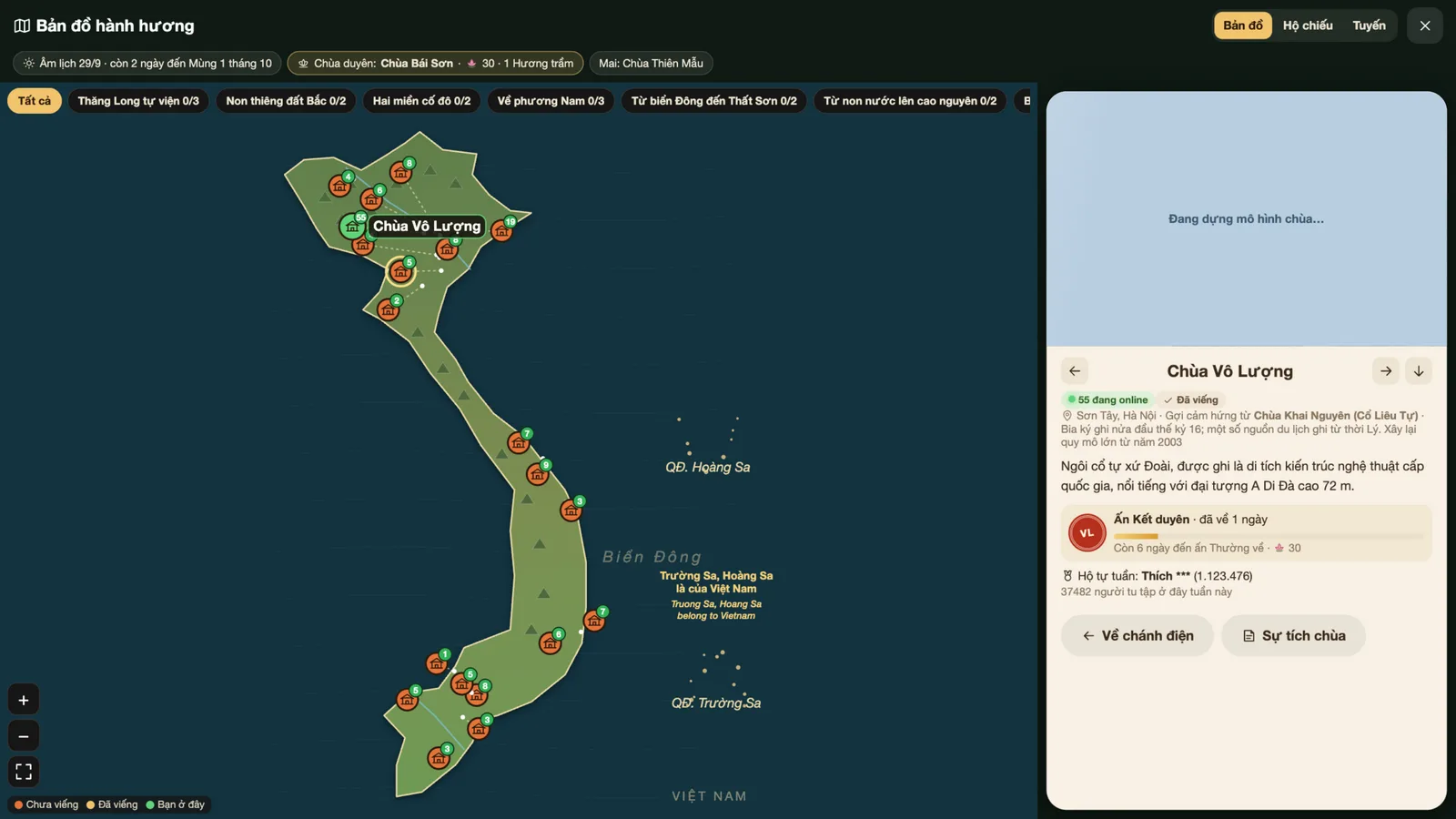
The Bản đồ hành hương (pilgrimage map) opens onto a stylised map of Vietnam dotted with temples from the north down to the south — over twenty at our check, from Chùa Vô Lượng in Sơn Tây, Hà Nội onward. Each card counts its live online players, marks whether you have visited, and keeps a lore page: the in-game abbot narrates each temple's story, weaving real places and history into the fictional temples.
Scale is the map's quiet flex: the card for Chùa Vô Lượng listed 37,482 practitioners for a single week in November 2026. A weekly golden board inside each temple commemorates its top practitioners.
Routes, destiny temples and passport stamps
Together with the lunar-calendar multipliers, the map turns the game into a slow tour of Vietnamese Buddhism — and the developers keep adding temples; the suggestion box (Góp ý) takes temple proposals.
- Six named pilgrimage routes (tuyến hành hương) chain temples by theme — Thăng Long's monastery cluster, northern landmarks, the ancient capitals, the southern temples, the eastern coast to Thất Sơn, and the highlands — completing a route pays a large reward.
- Every day one temple is the chùa duyên (destiny temple); visiting it pays extra Sen and incense.
- Each visited day adds a stamp (ấn) to your passport (Hộ chiếu); stamp tiers advance at 7, 21 and 49 days of visited temples.
The courtyard: chores, gardens and minigames
- Công quả (temple chores) — sweep the courtyard (three sweeps per temple per day) and plant a tree (one per temple per day); planted trees stay for everyone to admire.
- Vườn Phật (Buddha garden) — buy a plant, place it in the yard, and harvest fruit every seven days; each fruit converts to 1 Ngọc. A lotus pot (50 Ngọc) yields 25 fruit across five harvests, a bodhi tree (100 Ngọc) 50, a sala tree (150 Ngọc) 75. Five trees per person, fifty per temple.
- Hứng hoa sala — a 45-second tray-catching minigame, three rounds a day, paying 10–40 Sen per round; catching 1,080 flowers in total earns the Áo Hoa Sala robe, with its own weekly leaderboard.
- Linh thú (spirit pets) — mythical creatures wander the yard; stand beside one for eight seconds to attempt a bond (kết duyên), five free tries a day. Rare species need level 5, forty successful bonds guarantee the blue lion Sư Tử Xanh, and duplicates pay out Sen instead.
Friends, retreat groups and wish lamps
There is deliberately no open chat channel to the hall — communication is greetings, gifts, wishes and reported names. The game masks names that get reported, and the moderation FAQ promises hidden content and bans for offenders.
- Click a fellow practitioner to send a greeting, gift incense, rejoice at their merit, or become đồng tu — friends can gift items to each other. Player cards show bows, rosary chains, streaks and equipped gear.
- Đạo tràng — practice groups you join with a code or from a list; when the group hits its shared weekly merit goal, every member receives 50 Sen and an incense stick.
- Đèn nguyện (wish lamps) — a public wall of floating-lantern wishes from every player; rejoicing at one notifies the owner and tips them 2 Sen.
- Sharing your achievement card to Facebook or Zalo pays 30 Sen the first time each day; a friend who joins through your link gives you both 100 Sen, and three invitations earn the lotus-dais cushion.
Chan pokes, hungry ghosts and house rules
The one mischievous system is chan: standing near someone and poking them playfully. Poking costs the poker 10 virtue points (tích đức) — the poked player loses nothing, anyone seated or practising cannot be poked, and each poke needs a cooldown. Run out of virtue and you turn into a ngạ quỷ (hungry ghost), reduced to walking the halls until you stand still and listen to a sutra for 30 minutes to regain 50 points; finishing a full sutra earns 5 virtue a day. A settings toggle opts out of the whole game.
House rules ask for gentle speech and respect for the Three Jewels: no advertising, no politics, no impersonating monastics, no automation tools and no exploiting bugs — violations can mean hidden messages, forced renames or bans. The game also reports bad wishes, messages and names through one-tap report buttons, ten per day.
And the last word belongs to the game itself: its help pages and terms repeat that in-game merit is a score encouraging a habit, real merit comes from how you treat people offline, and when you can, visiting a real temple is still better for learning. The guide second that.